






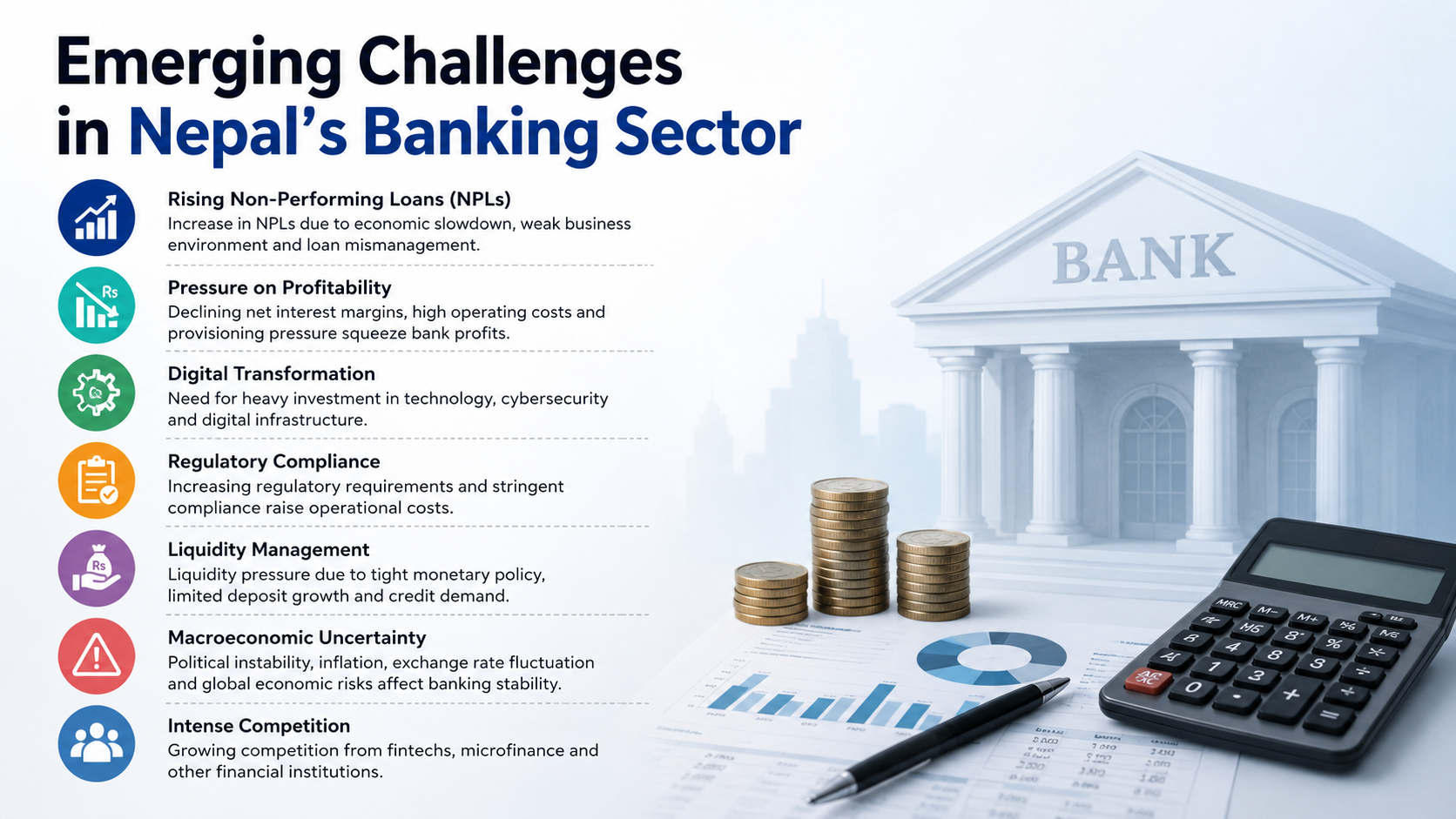
Nepal’s banking sector is entering a more complex phase. The system is not facing an immediate collapse—capital and liquidity indicators remain broadly adequate—but the nature of the risks is changing. The biggest challenge is no longer simply “having enough liquidity”; it is maintaining asset quality, profitability, capital strength and public confidence while adapting to slower credit demand, digitalisation and tighter regulation.
The latest available evidence from Nepal Rastra Bank (NRB), including its FY2024/25 Financial Stability Report and 2026 macroeconomic assessment, points to several emerging challenges.
- Rising non-performing loans (NPLs)
This is probably the single biggest challenge for Nepal’s banks.
The banking sector’s gross NPL ratio increased sharply from around 1.3% in January 2022 to 5.2% in April 2025. It subsequently moderated, but the IMF reported that the financial sector’s NPL ratio had risen again to 5.4% in January 2026.
The problem is important because an NPL does not simply mean that a borrower has missed a payment. It creates a chain reaction:
Weak borrower → delayed repayment → NPL → higher provisioning → lower profit → weaker capital generation → reduced ability to lend.
Agriculture and SME loans have shown relatively greater stress, according to NRB.
Why are NPLs increasing?
Several factors are interacting:
- Post-pandemic economic slowdown
- Weak business demand
- Problems in construction and real estate
- Lower turnover and profitability of businesses
- Earlier aggressive credit expansion
- Weak collateral recovery mechanisms
- Loan restructuring and refinancing pressures
- Borrowers affected by lower asset prices
- Difficulties selling collateral quickly
NRB itself has noted that banks are increasingly concentrating on loan recovery rather than business expansion because of rising NPLs.
Why this matters
If NPLs remain elevated for a long period, banks can become more conservative. They may have money available but become reluctant to lend.
That creates a paradox:
Nepal can have excess liquidity in the banking system while businesses simultaneously complain that productive credit is difficult to obtain.
- The credit-demand problem
For many years, Nepal’s banking challenge was described as “lack of liquidity.”
Today, the situation is increasingly different.
NRB’s February 2026 macroeconomic report noted that private-sector credit remained subdued despite abundant liquidity and historically low interest rates. In other words, banks have lending capacity, but borrowers are not necessarily demanding credit at the same pace.
This creates a major business challenge for banks.
Banks earn much of their income from lending. If:
Deposits ↑ → liquidity ↑ → loan demand ↓
then banks face pressure on:
- Net interest income
- Interest spreads
- Return on assets
- Return on equity
- Overall profitability
Banks therefore have to find new productive lending opportunities rather than simply expanding loan volumes.
- Declining quality of collateral
Nepali banking is heavily collateral-based.
Land and buildings have historically been among the most important forms of security for bank loans. But when real-estate transactions slow or property prices become uncertain, the traditional collateral model becomes less effective.
Suppose a business borrows Rs. 100 million against property valued at Rs. 150 million.
If the borrower defaults and the property can be sold for only Rs. 90 million after a prolonged recovery process, the bank may still face a loss despite having apparently sufficient collateral.
This creates a critical distinction:
Collateral value ≠ immediately recoverable value.
Banks therefore need to focus more heavily on:
- Cash-flow based lending
- Business viability
- Debt-service capacity
- Sectoral risk
- Borrower credit history
- Quality of financial statements
rather than relying excessively on property collateral.
- Capital adequacy and loss-absorption capacity
Nepal’s banking system remains above regulatory capital requirements overall, but capital is becoming a more important issue as asset quality deteriorates.
NRB reported that in November 2025 the banking system’s core capital-to-risk-weighted-assets ratio was 9.80%, while total capital adequacy was 12.89%.
The concern is not necessarily that all banks are undercapitalised.
The concern is how much additional loss banks can absorb if NPLs continue rising.
Higher NPLs require higher provisions.
Higher provisions reduce profits.
Lower profits make it harder to generate capital internally.
Therefore:
NPL ↑ → Provision ↑ → Profit ↓ → Internal capital generation ↓
This is particularly important for banks with relatively thin capital buffers.
The IMF has also highlighted that some individual banks have faced difficulties meeting capital conservation requirements.
- Profitability pressure
Nepali banks are facing a structural profitability challenge.
The traditional banking model was relatively straightforward:
Collect deposits → lend at higher rates → earn interest spread.
But this model is becoming more difficult.
Banks are now dealing with:
- Lower lending rates
- Intense competition
- High liquidity
- Slower credit demand
- Higher NPL-related costs
- Increased technology expenditure
- Compliance costs
- Cybersecurity expenditure
- Pressure to reduce service charges
- Greater competition from digital financial services
When banks compete aggressively for borrowers, loan rates can fall faster than operating costs.
At the same time, banks cannot indefinitely reduce deposit rates because depositors may move toward other investment alternatives.
This creates pressure on net interest margins.
- Real-estate and construction concentration risk
Real estate remains one of the most important sources of systemic risk.
Nepal’s credit cycle has historically been strongly connected with:
- Land
- Housing
- Construction
- Real estate developers
- Property-backed business loans
The IMF has specifically identified asset-quality risks associated with the construction and real-estate sectors.
The danger is interconnectedness.
For example:
Real-estate slowdown → property prices/transactions weaken → developer cash flow deteriorates → loan repayment weakens → bank NPLs rise → collateral recovery becomes difficult → bank profitability falls.
This is why regulators are increasingly concerned about concentration rather than looking only at the overall NPL ratio.
- Digital banking and cyber risk
Digitalisation is one of the biggest opportunities for Nepal’s banking industry—but also one of its fastest-growing risks.
Customers increasingly expect:
- Mobile banking
- Internet banking
- QR payments
- Instant transfers
- Digital onboarding
- Cardless transactions
- Online loans
- Digital wallets and interconnected payment systems
But greater digital dependence creates vulnerabilities.
Banks must protect against:
- Phishing
- Social engineering
- Account takeover
- Malware
- Data theft
- Identity fraud
- Payment-system attacks
- Insider threats
- API vulnerabilities
- Third-party technology risks
The challenge is that cybersecurity investment is expensive, but one major security incident can damage public confidence much more quickly than a bank can rebuild it.
So cybersecurity is no longer merely an IT department issue. It is becoming a core banking and financial-stability issue.
- Fraud and financial crime risks
Banks are also operating in an environment of increasingly sophisticated financial crime.
The risks include:
- Money laundering
- Fraudulent transactions
- Identity misuse
- Account-mule networks
- Digital-payment fraud
- Misuse of corporate accounts
- Suspicious cross-border transactions
As financial transactions become faster and more digital, traditional manual monitoring becomes less effective.
Banks therefore need better:
- Transaction monitoring
- Customer due diligence
- Beneficial ownership identification
- AI/data-based fraud detection
- Suspicious transaction reporting
- Internal controls
The challenge is balancing strong AML/CFT controls with convenient customer service.
- Loan evergreening and weak credit discipline
Another serious challenge is the possibility of evergreening—providing new or restructured credit to borrowers so that problematic loans appear healthier than they really are.
The objective of strong credit regulation is therefore not merely to prevent bad loans, but also to ensure that:
A bad loan is recognised as a bad loan at the right time.
The IMF has specifically stressed the importance of avoiding regulatory forbearance and ensuring that working-capital-loan rules do not permit evergreening practices to return.
This is crucial because delayed recognition can make the eventual problem much larger.
- Loan recovery and legal enforcement
Nepal has another structural problem: recovering bad loans can take a long time.
A bank may have a technically valid claim and sufficient collateral, but that does not necessarily mean the bank can quickly convert that collateral into cash.
Problems can involve:
- Court proceedings
- Valuation disputes
- Property transfer complications
- Borrower resistance
- Insolvency procedures
- Auction difficulties
- Weak distressed-debt markets
The IMF has therefore emphasised improvements in debt enforcement, insolvency systems and distressed-debt markets before relying heavily on an Asset Management Company (AMC) to resolve NPLs.
- Asset Management Company: opportunity and risk
Nepal is considering a framework for an Asset Management Company (AMC) to help deal with problematic loans.
In principle, an AMC could purchase distressed assets from banks and help clean up bank balance sheets.
For example:
Bank → transfers bad loans → AMC → bank receives consideration → bank balance sheet becomes cleaner
But this is not a magic solution.
If bad loans are simply transferred at unrealistic prices, the problem may move from the banking system to another institution.
The IMF has warned that an AMC must have strong rules covering:
- Governance
- Asset valuation
- Eligible loans
- Transfer pricing
- Financing
- Duration
- Accountability
Otherwise, it could create moral hazard and even fiscal risks for the government.
- Regulatory transition toward Basel standards
Nepal’s banking sector is moving toward stronger international regulatory standards.
NRB is reviewing its capital adequacy framework and preparing implementation of measures such as:
- Liquidity Coverage Ratio (LCR)
- Net Stable Funding Ratio (NSFR)
- Risk-based supervision
- Stronger asset classification
- Improved bank-resolution mechanisms
The IMF has noted these reforms as part of Nepal’s effort to strengthen financial-sector resilience.
For banks, however, stronger regulation means additional:
- Capital requirements
- Technology investment
- Reporting requirements
- Risk-management systems
- Compliance costs
- Data-quality requirements
The challenge is implementing these reforms without unnecessarily constraining credit to the economy.
- Governance and management quality
Another emerging challenge is governance.
A bank can have sufficient capital and liquidity but still become vulnerable because of poor:
- Credit underwriting
- Board oversight
- Risk management
- Related-party lending controls
- Internal audit
- Compliance
- Management accountability
This is particularly important because banking is fundamentally a trust business.
A few large bad loans arising from weak governance can have a disproportionately large impact on a bank’s balance sheet.
The future of Nepalese banking therefore requires stronger separation between:
business growth decisions and political, shareholder or management pressure.
- Concentration risk
Nepali banks can become vulnerable when too much credit is concentrated in a small number of sectors or borrowers.
For example, excessive exposure to:
- Real estate
- Construction
- Hydropower
- Share-market-related lending
- Large corporate groups
- Import-dependent businesses
can create systemic problems if one sector experiences a downturn.
The solution is not necessarily to stop lending to these sectors. Rather, banks need better portfolio diversification and risk-based pricing.
- Directed and deprived-sector lending
Nepal has policies requiring banks to lend to priority or deprived sectors.
These policies have important social and economic objectives.
However, there is a potential trade-off.
If banks are required to lend heavily to sectors where repayment capacity is weak, banks may accumulate credit risk.
The IMF has recommended reviewing directed-lending policies so that they do not force banks to increase exposure to already weak sectors without sufficient risk assessment.
The emerging challenge is therefore:
How can Nepal achieve financial inclusion without compromising credit quality?
- Competition from fintech and digital financial services
Banks are no longer competing only against other banks.
They increasingly compete with:
- Digital wallets
- Payment service providers
- Fintech companies
- Digital lending platforms
- Payment gateways
- Technology companies
This changes customer expectations.
Customers increasingly expect banking to be:
instant + cheap + mobile + available 24/7.
Traditional banks have expensive branch networks and legacy systems.
The challenge is to modernise without destroying profitability.
- Changing customer behaviour
The younger generation is increasingly comfortable with digital financial services.
Customers may no longer care about:
“Which bank has the largest branch network?”
Instead, they may ask:
“Which bank has the fastest app, lowest fee and easiest digital loan?”
This means banks must compete on technology and customer experience, not just deposit rates and branch locations.
- Climate and disaster-related credit risk
This is an emerging issue that Nepal’s banks will increasingly have to take seriously.
Nepal is exposed to:
- Floods
- Landslides
- Earthquakes
- Glacial and mountain hazards
- Extreme rainfall
- Climate-related agricultural losses
When a disaster destroys a business, house, road, hydropower project or agricultural operation, the bank financing that asset can suddenly become stressed.
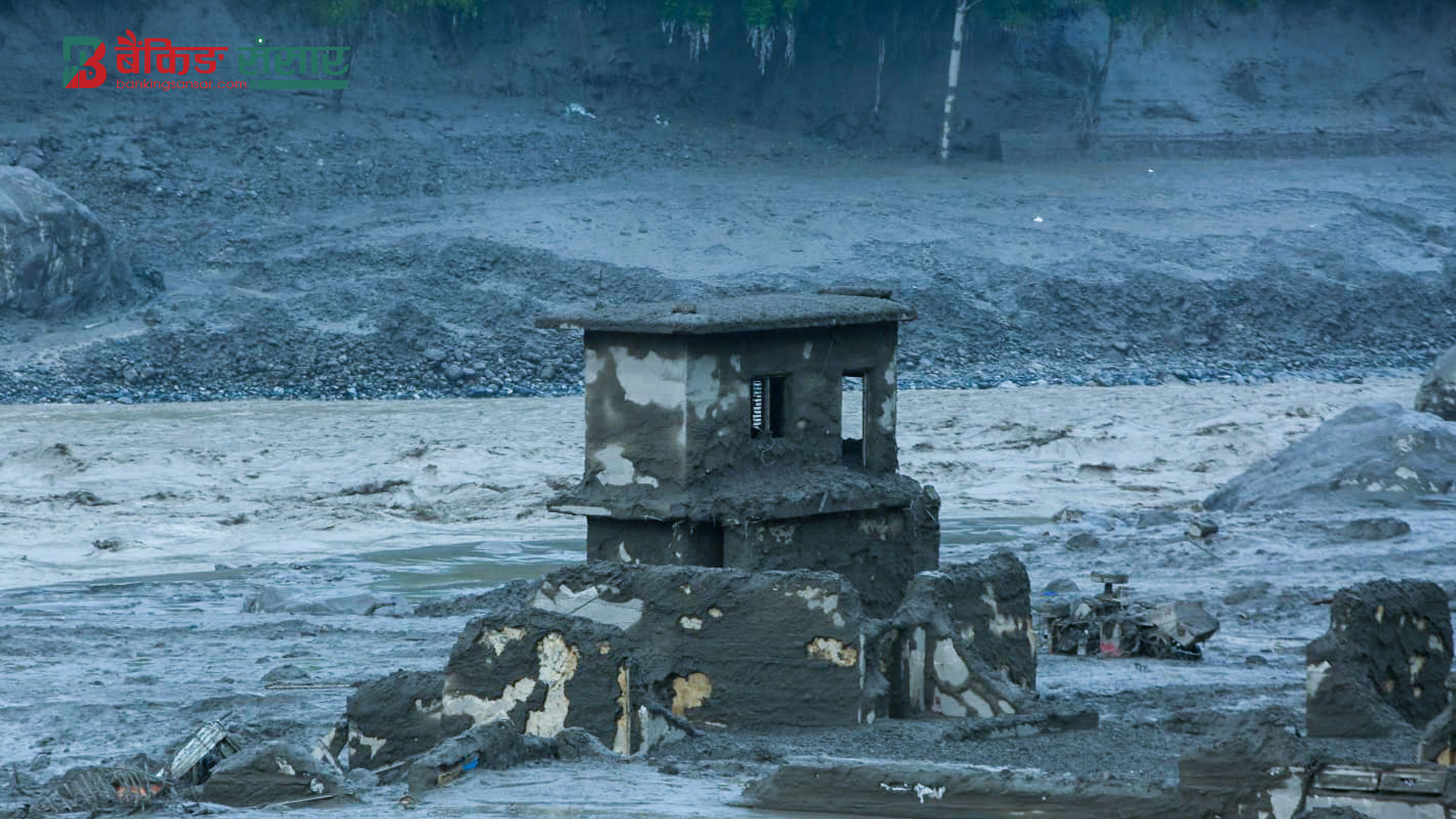
The recent flooding and infrastructure damage in Nepal is a good illustration of this broader risk.
For banks, climate/disaster risk can become:
Physical damage → business interruption → cash-flow loss → loan repayment problem → NPL → collateral-value deterioration.
Banks therefore need climate-risk assessment within credit underwriting and stress testing.
- Liquidity risk is changing rather than disappearing
Nepal has recently experienced periods of abundant liquidity, but that does not mean individual banks are permanently immune from liquidity risk.
A bank can have sufficient liquidity at the system level while an individual institution faces deposit withdrawals.
The NRB’s stress-testing work shows why this matters: financial institutions can become highly vulnerable when deposits are withdrawn rapidly.
Therefore banks need to manage both:
normal liquidity and stress liquidity.
- Public confidence and depositor behaviour
Perhaps the most underestimated risk is confidence.
Banking is based heavily on trust.
If depositors suddenly believe that a bank is unsafe, even a fundamentally viable bank can experience liquidity pressure.
This is why problems involving:
- Cooperatives
- Development banks
- Finance companies
- Bank failures
- Fraud cases
- Viral social-media rumours
can potentially affect public perception of the wider financial system.
The challenge for regulators and banks is therefore not simply maintaining financial ratios, but also maintaining confidence and transparency.
The bigger picture
The most important thing to understand is that Nepal’s banking challenge is shifting from liquidity to asset quality and sustainable growth.
A simplified picture is:
| Earlier major concern | Emerging concern |
| Liquidity shortage | Excess liquidity + weak credit demand |
| High interest rates | Low lending rates and margin pressure |
| Rapid credit expansion | Quality of credit |
| Deposit mobilisation | Productive deployment of deposits |
| Property collateral | Cash-flow and business viability |
| Loan growth | NPL management |
| Branch expansion | Digital transformation |
| Traditional fraud | Cyber/digital fraud |
| Basic regulation | Basel-aligned risk management |
| Individual bank risk | Systemic/concentration risk |
What should Nepalese banks focus on?
- Improve credit underwriting
Banks need to assess cash flow, repayment capacity and business fundamentals, not simply collateral.
- Build stronger NPL recovery systems
The objective should be early identification and recovery rather than allowing bad loans to remain unresolved for years.
- Strengthen capital buffers
Banks should maintain sufficient capital to absorb unexpected shocks rather than operating too close to regulatory minimums.
- Diversify loan portfolios
Overdependence on real estate and a small number of sectors should be reduced.
- Invest aggressively in cybersecurity
Cybersecurity should be treated as a board-level risk rather than merely an IT expense.
- Modernise banking technology
Legacy systems will increasingly become a competitive disadvantage.
- Improve governance
Strong boards, independent risk management and effective internal controls are essential.
- Develop better distressed-asset markets
Nepal needs mechanisms through which bad loans can be resolved efficiently rather than remaining stuck on bank balance sheets.
- Improve insolvency and debt-recovery systems
Faster recovery would improve both bank profitability and credit availability.
- Develop climate-risk frameworks
Banks should begin pricing disaster and climate risk into long-term lending decisions.
Bottom line
Nepal’s banking sector is not currently defined by one single crisis. It is facing a transition.
The immediate concern is rising NPLs and weak loan recovery. The medium-term concern is whether banks can maintain profitability and capital while credit demand remains weak. The longer-term challenge is whether Nepal’s banks can transform themselves from collateral-driven, branch-heavy lenders into technology-driven, risk-based financial institutions.
The latest NRB data still show adequate aggregate capital and liquidity, so the correct conclusion is not that Nepal’s banking system is on the verge of collapse. Rather, the system has vulnerabilities that require early management. NRB itself is strengthening supervision, capital frameworks, liquidity standards and NPL-resolution mechanisms.