





Kathmandu. The exam conducted by the Public Service Commission is not an ordinary exam for many. It is a test related to years of hard work, the hope of the family, and the dream of changing one’s future. Therefore, the common man has a deep faith in the Public Service Commission, here at least fairness and accuracy are not compromised.
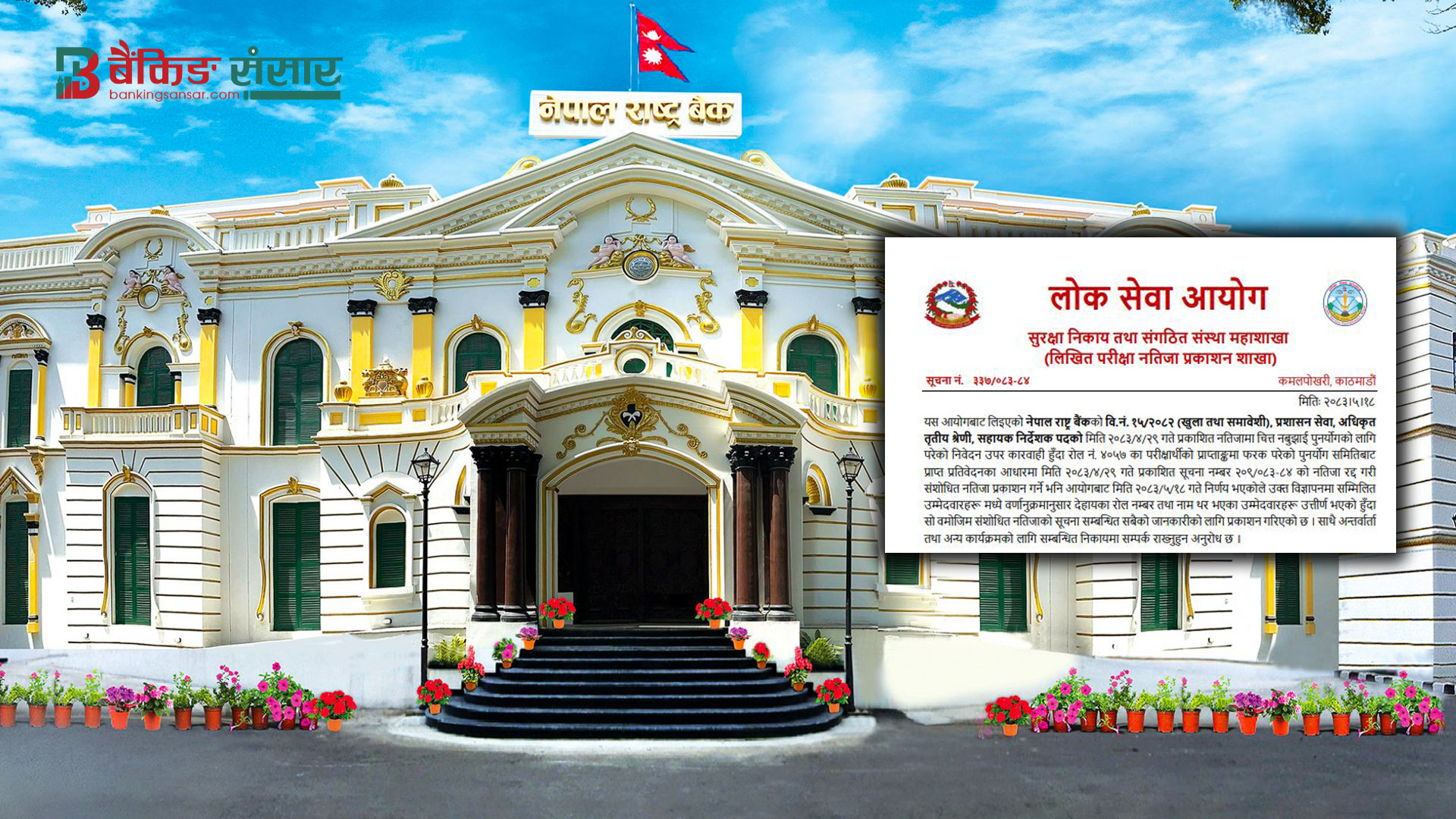
However, the results of the written examination for the post of Assistant Director of Nepal Rastra Bank have raised serious questions about this trust.
The Public Service Commission published the results of the examination on August 12, where a total of 1,077 candidates participated. The results came, the names of some came, some did not. Normally, the subject should be finished after that. However, some candidates who were not satisfied with the results applied for retotaling, and the published results of the commission were questioned.
During the retotaling, Sandeep Luitel’s score of roll number 4057 was different. Luitel, who was initially said to have failed, actually passed in the open category. That is, he did not fail the exam, but the public service had made him fail.
This is not a simple technical error.
The commission has admitted its serious negligence and revised the results published on August 12. Initially, it was said that 31 students passed in the open category, but the number has increased to 32 in the revised results. In the women’s category, 20 were initially said to have passed, but later 21 have been added. Sunita Khanal’s name has also been added to the revised results. In all, the names of 60 people were initially published but later 62 were published.
The addition of two examinees may not be a large number in itself. But the question is not that two candidates were added. The question is, how did the passer show failure?
The Public Service Commission says that there is a process of adding, verifying and re-verifying the marks after checking the answer sheets. If such a multi-layered process really takes place, then how did there be such a big difference in the marks of at least two candidates, not just one examinee?
Did the person who added the marks given by the examiner in the answer sheet miss or not? Did the person who verified the added marks mistaken? Was there an error while preparing the final result? Or did all these levels not see the same mistake?
The Commission must answer these questions.
Because the cost of making a mistake in the Public Service Commission is not as simple as correcting an office paper. There, one mark can make someone’s years of hard work unsuccessful. One mark can push someone out of a job opportunity. A wrong total can change the course of someone’s career.
What would have happened if Sandeep Luitel had not applied for the retotaling?
Perhaps he would return home with a failing certificate. He would be satisfied that the exam he had done well had failed. He would prepare for it next time. But the reality was different – he had passed.
This is where the most serious aspect of this incident begins.
The results have not been revised and the problem has not been solved; rather, it has proved how deep the problem is.
The Public Service Commission should not move forward only by considering it as a procedural weakness. Because the question is not of the information of the Commission, but of the credibility that the Commission has built over the years.
What is the basis of trust in the Public Service Commission? The belief that the person checking the answer sheets is impartial. The belief that the marks will be calculated correctly. The belief that there will be enough verification before the results are published. And most importantly, the belief that the qualified person will get the opportunity and the unqualified person will not move forward due to procedural weaknesses.
However, if there is a mistake in this process, the impartiality of the commission will be questioned.
More seriously, according to the commission, this is probably the first time that the results have been different after retotaling. Even if it is indeed the first, the reason should be made public. Otherwise, it is natural to question whether such errors were made in the past but the examinees did not come out because they did not do retotaling.
Therefore, it is no longer enough for the commission to say, ‘Mistake was made, we corrected’.
Why did the error happen? At whose level did it happen? At what level did the verification system fail? What is the guarantee that such mistakes will not be repeated? The Commission has to answer these questions.
The government should also not take it as a general administrative weakness. The Public Service Commission is a constitutional body. The citizens have faith in their future in its examination system. Even a small weakness there has a big institutional impact.
The biggest pain in this case is that of the examinees, who failed not because of their own ability, but because of the mistake of the system. Luitel’s name came in the revised list, Sunita Khanal’s name was added. But the question arises – who will take responsibility for that unnecessary mental pressure and lost time?
There can be a debate about whether the Public Service Commission should apologize or not. But at least it should publicly explain the shortcomings of its system and give a concrete plan for reform.
Because the Public Service Commission is not an institution that conducts any general examination. It is the main door for the state to select the qualified manpower. If there is a situation where it is not able to add marks at that door, cannot verify the marks added and cannot find fault with the final result, then the problem is not with the examinee, but with the system.
We should not see the Public Service Commission only as an office to prepare question papers, check answer sheets and produce results. It is an institution of public trust. Therefore, the word ‘human error’ should not cover all the mistakes here.
This incident should not be limited to the fact that the names of two candidates have been added to the results. It should be made an opportunity to improve the examination system of the commission.
The Public Service Commission should conduct an inquiry. The government should also conduct an independent study if necessary. Whether there were such errors in the past results or not, it should also be reviewed. Responsibility and accountability should be clarified at every level from the examination of answer sheets to the publication of the final results.
Because the Public Service Commission is not a place to add points to anyone’s whims. It is an institution that millions of youths consider as the door to their future.
Adding a number wrong is not just a mathematical mistake. It is a serious injustice to someone’s dream, hard work and future.
And to prevent such injustice from happening again, the commission must respond not only by correcting the results but also by correcting its own system.
The onus is now on the shoulders of the Commission to reaffirm its faith in the Public Service Commission.